Introduction
Walk out to your driveway and look at the side of your tire. You will see a jumble of letters, numbers, and symbols that look more like a secret military code than consumer information. To most drivers, these tire sidewall markings explained nothing. They are just hieroglyphics.
But to a mechanic or a savvy car owner, those numbers tell a complete story. They tell you if your tires are safe, if they can handle your car’s weight, and—most importantly—if you are about to be scammed. Unscrupulous shops have been known to sell “new” tires that have been sitting in a warehouse for six years, rotting from the inside out.
Understanding this code isn’t just automotive trivia; it is a financial shield. By learning to read your sidewall, you can ensure you are getting exactly what you paid for and avoid specialized tire failures that your insurance company might refuse to cover.
1. The Big Numbers: Decoding Tire Size
The most prominent string of characters on your tire (e.g., 225/45R17) is the size. While it looks like a math equation, it is actually three distinct measurements smashed together.
- Width (225): The first number is the width of the tire in millimeters, measured from sidewall to sidewall. A higher number means a wider tire, which generally offers more grip but can lower fuel economy.
- Aspect Ratio (45): The second number is the “profile” or height of the tire sidewall, expressed as a percentage of the width. In this example, the sidewall height is 45% of 225mm. Lower numbers (like 35 or 40) mean “low profile” tires, which look great and handle well but ride harsher.
- Rim Size (17): The final number following the “R” (which stands for Radial construction) is the diameter of the metal wheel in inches. You cannot squeeze a 16-inch tire onto a 17-inch rim; the fit must be exact.
2. The DOT Code: How to Spot a “New” Old Tire
This is the most critical section for your wallet and safety. Every tire sold in the US must have a DOT (Department of Transportation) code. This code ends in a four-digit number that acts as a birth certificate.
Shady retailers sometimes buy old, unsold stock for pennies on the dollar and sell them as “new” because they have never been driven on. However, rubber degrades over time due to oxidation, even if it just sits on a shelf. A tire that is six years old is often unsafe, regardless of tread depth.
Here is how to check tire age dot code quickly:
- Locate the DOT string: Look for the letters “DOT” on the sidewall, followed by a series of letters and numbers.
- Focus on the last 4 digits: These are the only ones that matter for age.
- The first two digits (The Week): These represent the week the tire was manufactured (01 to 52).
- The last two digits (The Year): These represent the year of manufacture.
- Example: A code ending in 3523 means the tire was built in the 35th week of 2023.
- Example: A code ending in 1018 means the tire was built in the 10th week of 2018. If a shop tries to sell you this tire today, refuse it. It is too old.
3. Speed Rating & Load Index: The Hidden Safety Limit
Following the tire size, you will see a separate code, such as 91V or 98W. This is not random; it dictates the physical limits of the tire.
- Load Index (e.g., 91): This number corresponds to a chart indicating how much weight one tire can support. A “91” can carry 1,356 lbs. If you cheap out and put a lower load index tire on a heavy SUV, the tire will overheat and could blow out on the highway.
- Speed Rating (e.g., V): The letter indicates the maximum safe speed the tire can sustain. “V” is rated for 149 mph, while “H” is rated for 130 mph. While you hopefully won’t drive that fast, a higher speed rating usually implies a stiffer sidewall and better cornering stability. Never downgrade your speed rating below what the manufacturer recommends, or you compromise the vehicle’s handling.
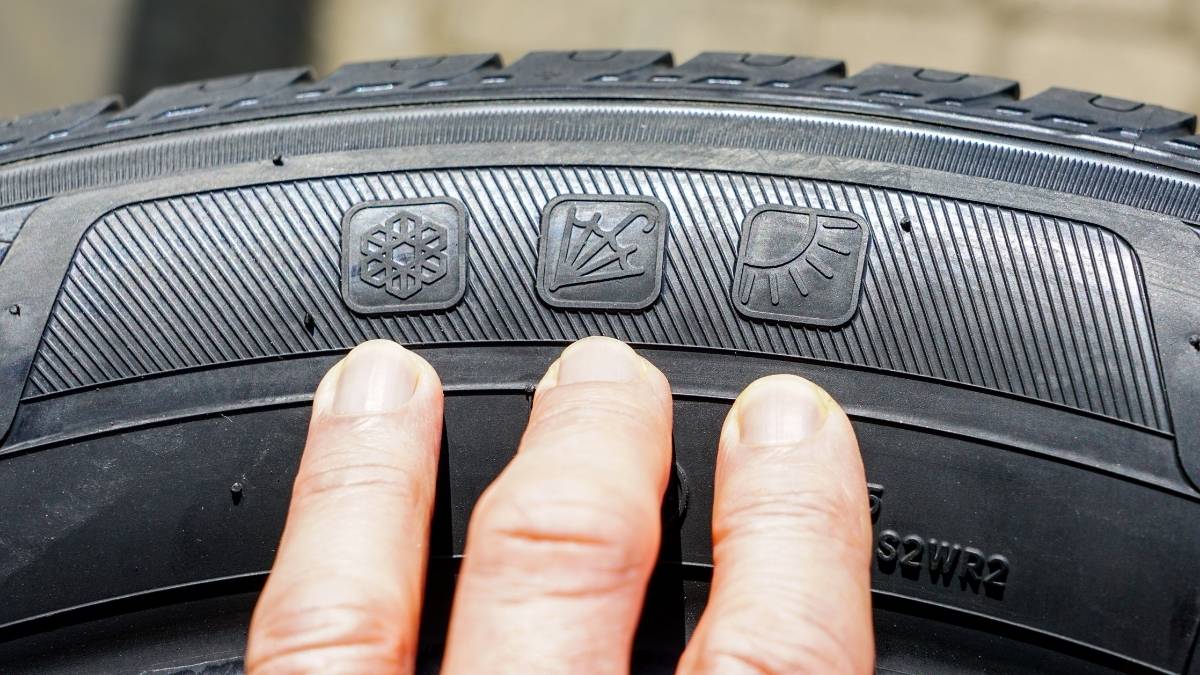
4. All-Season vs. Summer vs. Winter: Picking the Right Rubber
The final piece of the puzzle is the tire type. The tread pattern and rubber compound determine when to replace car tires based on the season.
- All-Season (M+S): Often marked with “M+S” (Mud and Snow), these are the jack-of-all-trades. They use a harder rubber compound to last longer (high mileage warranty) but sacrifice ultimate grip. They are fine for rain and light dusting, but mediocre in extreme heat or deep snow.
- Summer Tires: These have fewer grooves and stickier rubber. They provide incredible grip on dry, warm roads but turn into hard hockey pucks in freezing temperatures, becoming dangerous.
- Winter Tires: Look for the “Three-Peak Mountain Snowflake” symbol. These are made of a silica-rich compound that stays soft in freezing temps. They are a necessity, not a luxury, if you live in the snow belt.
Conclusion
Your tires are the only thing connecting your 4,000-pound vehicle to the road. The contact patch is roughly the size of your hand. Trusting that small patch to a mystery tire is a gamble you shouldn’t make.
Next time you are in the market, don’t just ask for “the cheapest thing that fits.” Read the sidewall. Check the DOT date to ensure you aren’t buying expired goods. Verify the load index handles your family’s gear. By spending five minutes decoding the sidewall, you ensure that your money buys you safety and longevity, not just a black rubber donut. Check your tire pressure monthly, rotate them every 5,000 miles, and drive with confidence.